Wednesday, November 18, 2020

Underground Railroad Primary Sources

 Dear Students, 

For Grade 5's: You will use images from Hands On Social Studies in class to look at primary sources for First Nations early interactions with Europeans. 

For Grade 6's, here are a couple of  slideshows showing some primary sources about the Underground Railroad:

https://www.eiu.edu/eiutps/Underground%20Railroad%20Primary%20Source%20Set.pdf

https://dp.la/primary-source-sets/the-underground-railroad-and-the-fugitive-slave-act-of-1850

https://digitalcollections.nypl.org/items/510d47dd-ff98-a3d9-e040-e00a18064a99/book?parent=205503f0-c6b4-012f-8a4d-58d385a7bc34#page/1/mode/2up

and here is a political cartoon showing you some of the ways the Underground Railroad was discussed in popular media like newspapers: 

https://digitalcollections.nypl.org/items/510d47dd-e87a-a3d9-e040-e00a18064a99#/?zoom=true


Pick one image that you connect with and reflect on it using our graphic organizer. 

Friday, April 3, 2020

Math Update

Dear Parents,

I have updated the pages section above. It continues to be a work in progress, but I've added a math tab and moved information that was on a previous page to other sections as appropriate. I hope these link suggestions are helpful and I appreciate your patience as I work through the other sections to streamline information, check working links, and support student learning where possible.

If you have not already connected with the school, I urge you to do so.

For Grade 6 students, under the science tab, you'll find a number of videos relating to the most recent unit on flight for Grade 6, with a worksheet (Ms. Goegan's Questions) that helps you click through on relevant games and short texts on the Smithsonian site, accessed through the link to Mr. Polsky's Page. I also recommend exploring the Fold and Fly link, where you'll get templates for  folding a wide variety of paper airplanes. 

Sincerely,

Lisa Goegan

Wednesday, January 8, 2020

Electricity and batteries

Dear Parents and Students,

In science, we've been looking at how we source electricity and how electricity gets transformed into different kinds of energy, for example in appliances.

We've been discussing the pros and cons of different energy sources and whether or not they can be considered "renewable" or "green". For instance, trees and wood are renewable sources, but give off carbon when burned and simply don't scale to the level that a large Western population uses. We'd use up all the trees if we attempted to heat everything with wood. There are also pluses and minuses to even hydroelectric power, which we tend to think of as clean and renewable, when dams are built on natural habitats or disrupt the water shed.

In many electrical devices, the electrical energy is transformed into a combination of heat, light, movement or sound energy. We've looked at a lot of different examples and tried to imagine the circuits inside that power them.

Today, we also looked inside batteries and talked about chemical energy. We compared 1.5V cell batteries with 9V batteries and talked about the difference between Volts and Kilojoules. For example, a D battery has more Kj than an AAA, but the same voltage: both are 1.5 V.  A 9V battery typically has 6 cells inside it, making up 9 volts altogether because 6 x 1.5 = 9.

Post image
From Reddit, showing the interior of different 9V batteries

I look forward to making wet cell batteries with the class in our next science session, so they can see the interior more clearly. 

Sincerely, 

Ms. Goegan

Saturday, December 21, 2019

Happy Holidays!

Dear Parents,

Wishing you the best over the New Year break. This time of year always brings out nostalgic memories of crafts and baking, so we sewed ornaments out of felt this past week and decorated gingerbread cookies. I've also sent home thank you notes for all kind gifts I received. Just in case they don't make it out of the backpacks, thank you very much again.

I've mostly done sewing with younger grades before and it's astonishing how much more Grade 6's can accomplish independently, but also what a wide range of skills and experiences they come with. On a personal note, this was deeply satisfying because one student in particular who hasn't been excited by any of my grand schemes so far this year was really happy about his newfound sewing skills.


We made circles

This badly cropped photo also shows some of the paper crafts we've been working on. This student embroidered a name into their pillow. 

This one is a snowflake

Here's a star

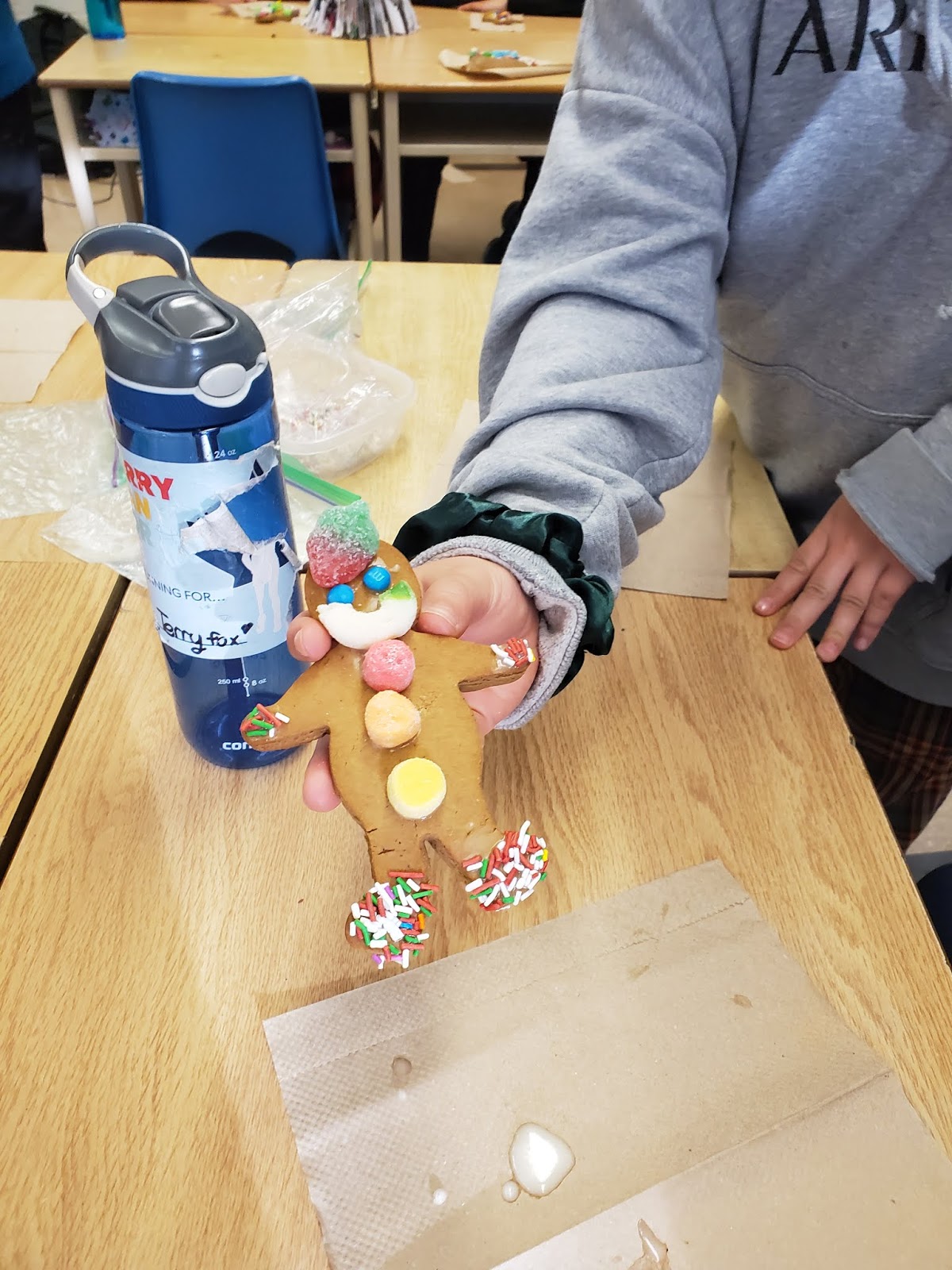
Here's the collection from Friday morning. You can also see a gingerbread man or two in there. 
 We mixed icing sugar with lemon juice and students used that to attach their candies and help create their gingerbread personalities:


In the afternoon, we watched Polar Express and I made hot chocolate, by student request after the Holiday Sing A Long.

Again, hoping you have a wonderful break. See you in 2020!

Sincerely,

Lisa Goegan

Monday, December 2, 2019

Literature Circles

Dear Parents,

Literature Circles are like book clubs for students. Each student has a role to complete and is marked on both their written completion of it and their oral participation in the group's meeting. We will also complete a spelling program and a Reading Response based on these books.

Each student takes a turn completing a different role. The roles I've chosen may change as students become more comfortable with the format and/or need to practice different skills. Each student received a package with all their role sheets and reading expectations in class. They will be given some time in class to complete but may need to bring work home, depending on their reading speed.

Extra copies of the role sheets can be found under the Language tab on this blog, in case students lose them.

For the first books we're reading students have chosen books that link to our social studies curriculum:

4 of these books link to different experiences of First Nations peoples and 3 link to other Canadian immigrant experiences (English/Irish, Chinese, and African). We wanted to give students lots of choices, so there's been some shuffling of books in the last week as new books I'd ordered arrived.

I have read or vetted all these books personally, and tried to pick books that were engaging, historically accurate, written by people from the community it discusses whereever possible, and age appropriate. If you have any questions or concerns about content or even how lit circles should work, please let me know.


Sincerely,

Ms. Goegan


Tuesday, November 19, 2019

Surrealism in Art

Dear Parents,

We were making some practice paintings of basic forms, like rectangular prisms and triangular prisms and cubes in order to practice using brushes to make large and small works.

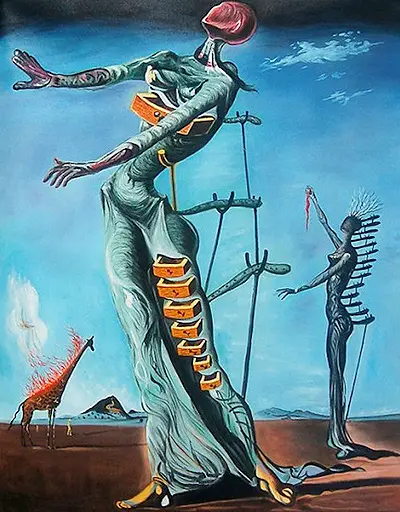
Then we  focusing in on the work of Rene Magritte, Salvadore Dali and Man Ray in the last week or so to see what inspiration they could add to our basic paintings.

Together in class, we've come up with some success criteria that these artists used that we can apply to our own work as well.

I asked students to pick one of the following to play with, but when we talked about the Magritte and Dali paintings, they saw that each artist played with all three.

--Be Playful:

•Play with SCALE (make it look big or small)

•Play with TEXTURE (melting, put holes in it)

•Play with CONTEXT (Add eyes or lips or something else that really doesn’t belong, make it dream-like)

--Make sure your additions look as realistic as possible

--Focus on either foreground or background

--Make your viewer question what is real and what is made up

Memory of a journey, 1955 - Rene Magritte
Memory of A Journey--Rene Magritte

Image result for dali crutches
The Burning Giraffe ---Salvadore Dali
The false mirror - Rene Magritte
The False Mirror--Rene Magritte
The Listening Room - Rene Magritte
The Listening Room--Rene Magritte

Here is a small selection of student work samples:


Sincerely, 

Lisa Goegan


Monday, November 18, 2019

Math Test Tomorrow

Dear Parents,

Tomorrow, we'll have a math test based on Lessons 1-5 of the Number Sense and Numeration Unit.

Students are asked to focus particularly on Rounding and Estimating. Today we reviewed leading digits, and the best strategy for rounding when adding vs. subtracting. All students were asked to bring their jump math workbook home and review page 36 in particular, if they have not already finished it in class today.

Our regular math homework will go home tomorrow, be focused on Data Management, and not due until Monday.

We also have grammar homework due Thursday and a grammar quiz (like one side of the homework) will happen on Friday, so that we have time to take it up.

Here's a photo from last Thursday with our snow mascot. Looking very much forward to next week's trip. Remember to return your forms asap, if you have not already!


Best, 

Ms. Goegan