We were making some practice paintings of basic forms, like rectangular prisms and triangular prisms and cubes in order to practice using brushes to make large and small works.
Then we focusing in on the work of Rene Magritte, Salvadore Dali and Man Ray in the last week or so to see what inspiration they could add to our basic paintings.
Together in class, we've come up with some success criteria that these artists used that we can apply to our own work as well.
I asked students to pick one of the following to play with, but when we talked about the Magritte and Dali paintings, they saw that each artist played with all three.
--Be Playful:
•Play with SCALE (make it look big or small)
•Play with TEXTURE (melting, put holes in it)
•Play with CONTEXT (Add eyes or lips or something else that really doesn’t belong, make it dream-like)
--Make sure your additions look as realistic as possible
--Focus on either foreground or background
--Make your viewer question what is real and what is made up
Memory of A Journey--Rene Magritte
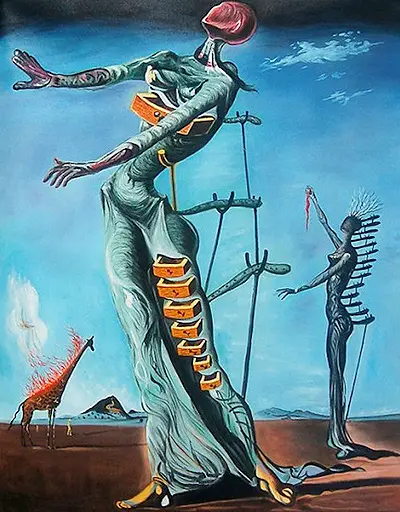
The Burning Giraffe ---Salvadore Dali
The False Mirror--Rene Magritte
The Listening Room--Rene Magritte
Here is a small selection of student work samples:
Tomorrow, we'll have a math test based on Lessons 1-5 of the Number Sense and Numeration Unit.
Students are asked to focus particularly on Rounding and Estimating. Today we reviewed leading digits, and the best strategy for rounding when adding vs. subtracting. All students were asked to bring their jump math workbook home and review page 36 in particular, if they have not already finished it in class today.
Our regular math homework will go home tomorrow, be focused on Data Management, and not due until Monday.
We also have grammar homework due Thursday and a grammar quiz (like one side of the homework) will happen on Friday, so that we have time to take it up.
Here's a photo from last Thursday with our snow mascot. Looking very much forward to next week's trip. Remember to return your forms asap, if you have not already!
I am excited that we have a new date and time for our overnight excursion. We will go to Camp Kearney on Wednesday, November 27th, and return on Friday, November 29th. I've distributed field trip forms and medical forms.
Here is a google slide presentation that will show you a little more about the Outdoor School and what it looks like:
Progress report cards will be coming out next week and in the interest of making things easy, I'm posting my available time slots so that you can schedule yourself in directly. Click on the link and choose a 15 minute slot that works for you (You may need to ensure the AW calendar is on the right date to see the times that are available). An email will be sent to me confirm the appointment.
Edited at completion: Here is the link to the shared google slide presentation. Please feel free to share your work with others. Editing has been completed. I will make this slideshow into a video that we can share.
3. Where did he/she come from
(hometown/reserve)?*
4. In what war(s) did he/she
serve?*
5. Did he/she receive any
medals for their service?Circle:yesno
If yes, which medal did he/she
receive and why?
6. Did he/she return home
from the war?
7. List 2-5 other facts you
learned about your Veteran:
8. If you could ask your
Veteran a question, what would you ask them?Why?
9. How do you think their experience of the war
might have been different from other soldiers?
Once you have completed this sheet, Ms. Goegan
will sign off and you will format your answers and a photo of this person into
a single google slide to display during our assembly on November 11th.
Remember: Not all your information needs to be
included on the final slide! Choose the important details to add in addition to
the items with a *.
(For the purposes of crediting others' work, this lesson comes from Tamara Hancock's excellent unit, Should I Wear a Poppy?)
After seeing the Mush Hole, we ate lunch in Berczy Park and students enjoyed interacting with the public art, like the trompe l'oeil building, the dog fountain, and the hands:
Class photo by L.B.W. Thank you!
We also enjoyed the Hockey Hall of Fame public sculpture
We had a bit of time, so we decided to take a longer route home and walk past some more sculptures in what was a kind of mini-labour history walk (the sources of inspiration for which I'm indebted to former Clinton Librarian Gini Dickie's connections to Maureen Hynes and Sue Smith).
We focused on 3 main sites as we walked west along Front: 1. WSIB Sculptures in Simcoe Park. There are two parts to this sculpture, a bronze cast of a worker carving the inscription "Remembering our Past, Building a Safe Future" by Lana Winkler and Derek Lo.
Photo fromWikipedia
Then a long shelf called 100 Workers (by John Scott and Stewart H. Pollock), covered with plaques memorializing workplace deaths of Canadians (1 per year in the 20th century). Some students were really interested in reading all the captions and names. We talked a bit about how laws and regulations were key to making people safer.
photo from Reddit
There's also a sculpture by Anish Kapoor, recently in the news for owning the rights to the blackest black (https://en.wikipedia.org/wiki/Anish_Kapoor), called Mountain. As with all these sculptures, students were keen to climb and explore.
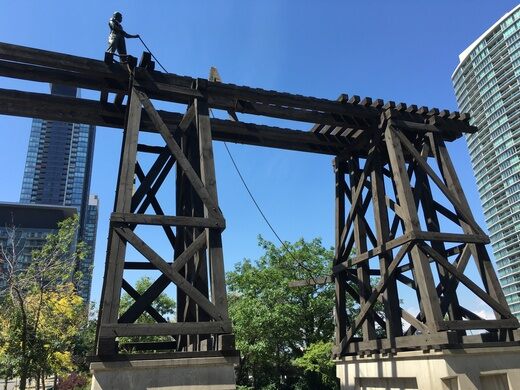
2. The Chinese Railroad Worker's Memorial, located at Spadina and Front near the Sky Dome, is by Eldon Garnet and Francis Le Bouthillier. We spent some time here talking about the history of the railway and the poor treatment of Chinese workers.
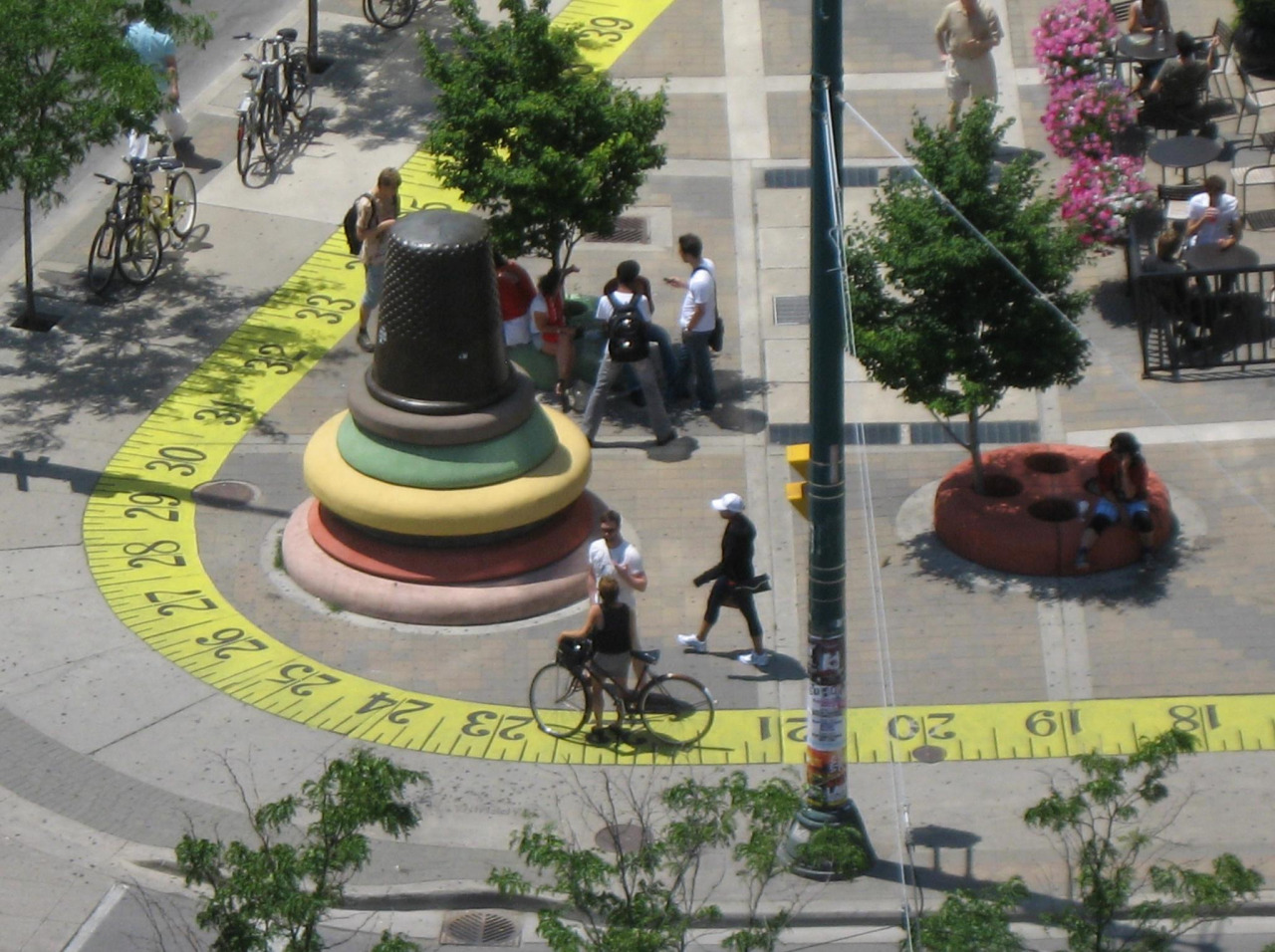
3. Finally, we stopped at The Thimble and Buttons at Richmond and Queen before getting on the streetcar back towards school. This piece, actually called Uniform Measure/Stack by Stephen Cruise, is missing the measuring tape that used to be part of it, but still commemorates the area's history as the Garment District.
I used this last stop to as an excuse to talk about the Triangle Shirtwaist Factory Fire, which was one of the deadliest industrial disasters ever. Because doors to the stairwells and exits were locked to prevent workers from taking unauthorized breaks, 146 people died, many of them women and recent immigrants. The outrage from this tragedy did lead to more regulations and safety standards. Here's a link to the Wiki article: https://en.wikipedia.org/wiki/Triangle_Shirtwaist_Factory_fire
Shirtwaist Factory Fire (photo from Wikipedia)
Spadina and Kensington Market is an area filled with the history of different groups that have emigrated to Toronto, from the Jewish community that dominated the areas in the 20's and 30's, the Hungarians in the 50's, the Chinese Canadian community and the Portuguese Canadian community starting in the 60's, all the way to the current influx of Latin American restaurants and food stores. I asked students to look for different languages as we went up the street and there were many different scripts to be found.
Of course, I barely skimmed the surface of this history in our little walk and I missed some bits that I'd loved to put in for a next time, but we enjoyed our walk and learned to always read the plaques.
Sincerely,
Ms. Goegan
P.S. There are so many rabbit holes to fall into on this topic, I couldn't resist adding some more articles--especially the ones with historical photos to help show the history in some more detail.
Our unit math test was delayed due to picture day on Thursday, but we're back on track. Today we spent time reviewing some of the key learnings that will be on the test. As a result, we don't have a math homework piece this week, but since our Jump Math workbooks have come in, I did send them home with students.
The chapter we've been working on covers material in pages 1-20. Some of that has already been done in class in their notebooks, or sent home as homework, but students who want to make sure they're prepared are welcome to use the book as extra practice for tomorrow. Students could also review the 2 unit quizzes that have already been sent home to see where they should focus in.
Going forward, we'll use the Jump Math workbook as our main focus for in class work.
.jpg!Large.jpg)
.jpg!Large.jpg)
.jpg!Large.jpg)