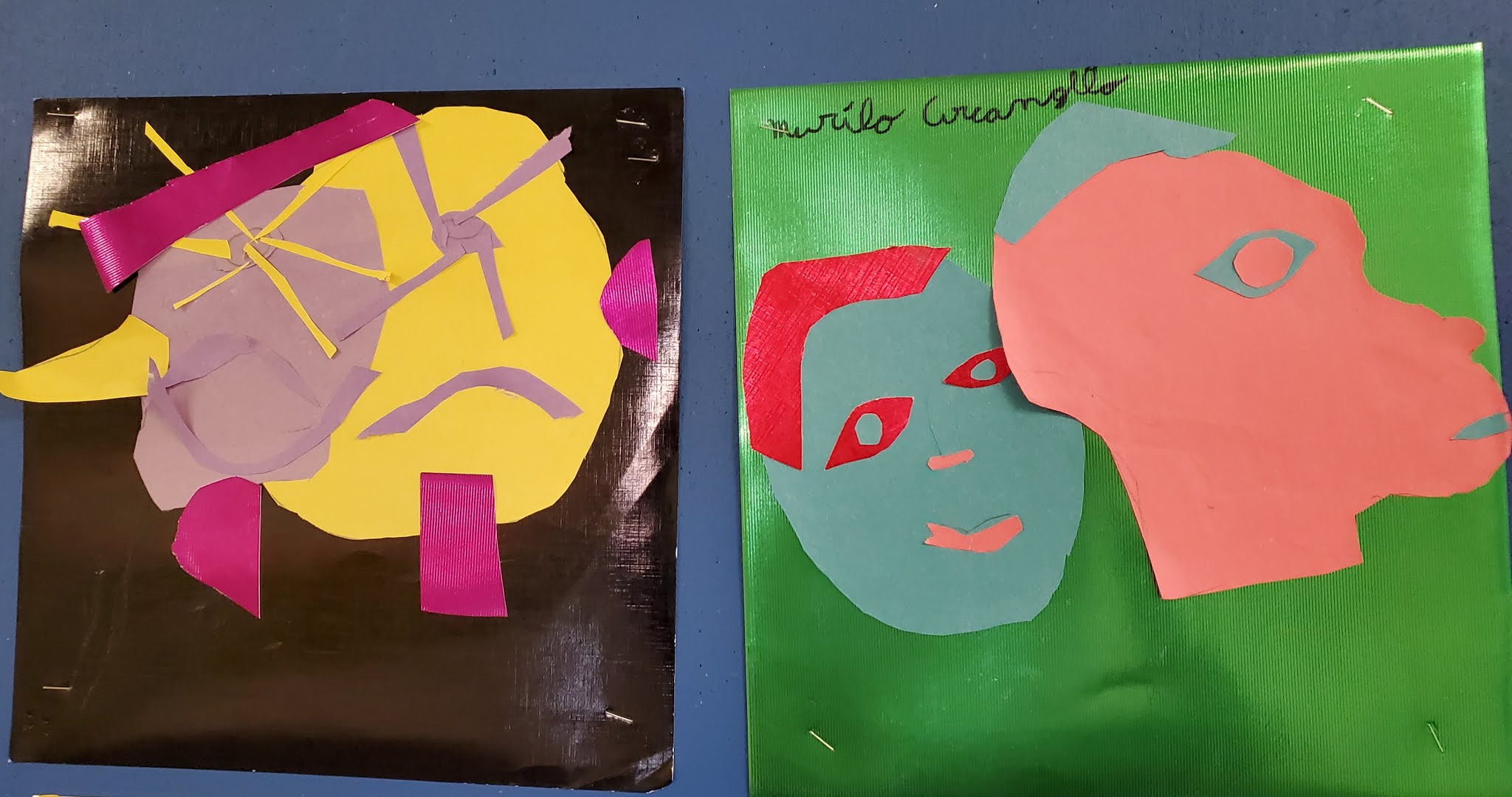
We created work that was inspired by Picasso and Matisse, and because we think of them as being modern, were surprised by the visual connections we found with traditional indigenous masks. Here are some sketches students made of First Nations and Inuit masks, displayed near our Cubist Self Portraits:
We'll discuss what we see, particularly thinking about how negative space plays into these sculptures, then look at an overview of Moore's work displayed worldwide:
For Grade 5's: You will use images from Hands On Social Studies in class to look at primary sources for First Nations early interactions with Europeans.
For Grade 6's, here are a couple of slideshows showing some primary sources about the Underground Railroad:
I have updated the pages section above. It continues to be a work in progress, but I've added a math tab and moved information that was on a previous page to other sections as appropriate. I hope these link suggestions are helpful and I appreciate your patience as I work through the other sections to streamline information, check working links, and support student learning where possible.
If you have not already connected with the school, I urge you to do so.
For Grade 6 students, under the science tab, you'll find a number of videos relating to the most recent unit on flight for Grade 6, with a worksheet (Ms. Goegan's Questions) that helps you click through on relevant games and short texts on the Smithsonian site, accessed through the link to Mr. Polsky's Page. I also recommend exploring the Fold and Fly link, where you'll get templates for folding a wide variety of paper airplanes.
In science, we've been looking at how we source electricity and how electricity gets transformed into different kinds of energy, for example in appliances.
We've been discussing the pros and cons of different energy sources and whether or not they can be considered "renewable" or "green". For instance, trees and wood are renewable sources, but give off carbon when burned and simply don't scale to the level that a large Western population uses. We'd use up all the trees if we attempted to heat everything with wood. There are also pluses and minuses to even hydroelectric power, which we tend to think of as clean and renewable, when dams are built on natural habitats or disrupt the water shed.
In many electrical devices, the electrical energy is transformed into a combination of heat, light, movement or sound energy. We've looked at a lot of different examples and tried to imagine the circuits inside that power them.
Today, we also looked inside batteries and talked about chemical energy. We compared 1.5V cell batteries with 9V batteries and talked about the difference between Volts and Kilojoules. For example, a D battery has more Kj than an AAA, but the same voltage: both are 1.5 V. A 9V battery typically has 6 cells inside it, making up 9 volts altogether because 6 x 1.5 = 9.
From Reddit, showing the interior of different 9V batteries
I look forward to making wet cell batteries with the class in our next science session, so they can see the interior more clearly.
Wishing you the best over the New Year break. This time of year always brings out nostalgic memories of crafts and baking, so we sewed ornaments out of felt this past week and decorated gingerbread cookies. I've also sent home thank you notes for all kind gifts I received. Just in case they don't make it out of the backpacks, thank you very much again.
I've mostly done sewing with younger grades before and it's astonishing how much more Grade 6's can accomplish independently, but also what a wide range of skills and experiences they come with. On a personal note, this was deeply satisfying because one student in particular who hasn't been excited by any of my grand schemes so far this year was really happy about his newfound sewing skills.
We made circles
This badly cropped photo also shows some of the paper crafts we've been working on. This student embroidered a name into their pillow.
This one is a snowflake
Here's a star
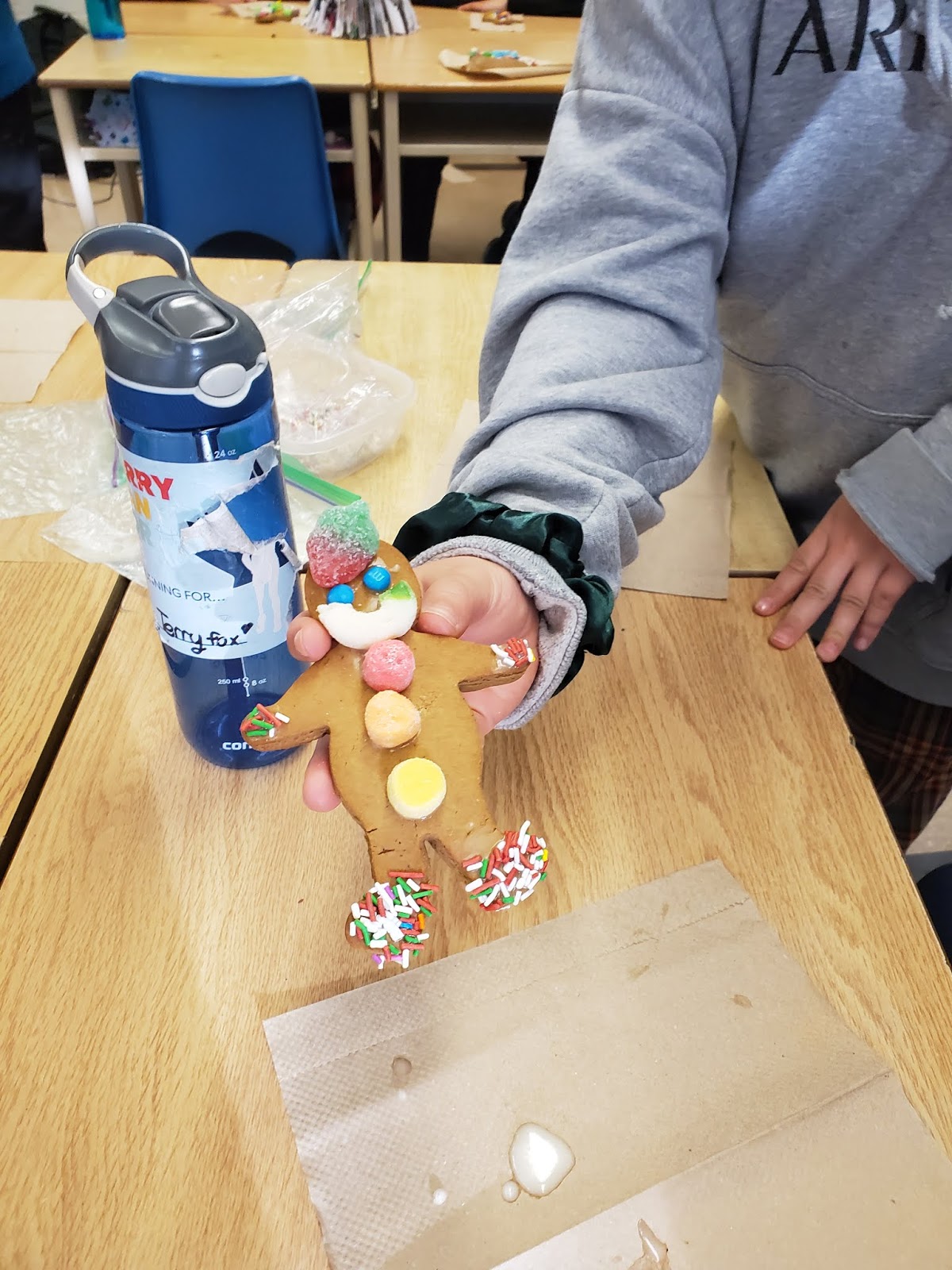
Here's the collection from Friday morning. You can also see a gingerbread man or two in there.
We mixed icing sugar with lemon juice and students used that to attach their candies and help create their gingerbread personalities:
In the afternoon, we watched Polar Express and I made hot chocolate, by student request after the Holiday Sing A Long.
Again, hoping you have a wonderful break. See you in 2020!
Literature Circles are like book clubs for students. Each student has a role to complete and is marked on both their written completion of it and their oral participation in the group's meeting. We will also complete a spelling program and a Reading Response based on these books.
Each student takes a turn completing a different role. The roles I've chosen may change as students become more comfortable with the format and/or need to practice different skills. Each student received a package with all their role sheets and reading expectations in class. They will be given some time in class to complete but may need to bring work home, depending on their reading speed.
Extra copies of the role sheets can be found under the Language tab on this blog, in case students lose them.
For the first books we're reading students have chosen books that link to our social studies curriculum:
4 of these books link to different experiences of First Nations peoples and 3 link to other Canadian immigrant experiences (English/Irish, Chinese, and African). We wanted to give students lots of choices, so there's been some shuffling of books in the last week as new books I'd ordered arrived.
I have read or vetted all these books personally, and tried to pick books that were engaging, historically accurate, written by people from the community it discusses whereever possible, and age appropriate. If you have any questions or concerns about content or even how lit circles should work, please let me know.
We were making some practice paintings of basic forms, like rectangular prisms and triangular prisms and cubes in order to practice using brushes to make large and small works.
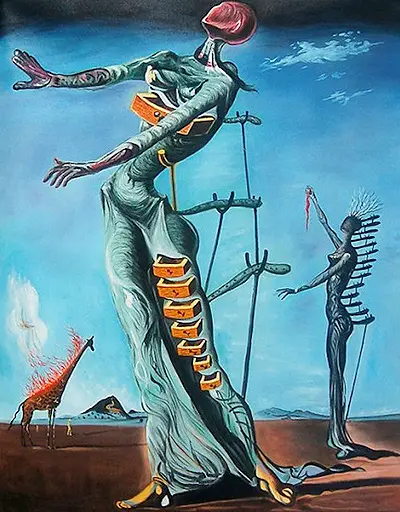
Then we focusing in on the work of Rene Magritte, Salvadore Dali and Man Ray in the last week or so to see what inspiration they could add to our basic paintings.
Together in class, we've come up with some success criteria that these artists used that we can apply to our own work as well.
I asked students to pick one of the following to play with, but when we talked about the Magritte and Dali paintings, they saw that each artist played with all three.
--Be Playful:
•Play with SCALE (make it look big or small)
•Play with TEXTURE (melting, put holes in it)
•Play with CONTEXT (Add eyes or lips or something else that really doesn’t belong, make it dream-like)
--Make sure your additions look as realistic as possible
--Focus on either foreground or background
--Make your viewer question what is real and what is made up
Memory of A Journey--Rene Magritte
The Burning Giraffe ---Salvadore Dali
The False Mirror--Rene Magritte
The Listening Room--Rene Magritte
Here is a small selection of student work samples:
Tomorrow, we'll have a math test based on Lessons 1-5 of the Number Sense and Numeration Unit.
Students are asked to focus particularly on Rounding and Estimating. Today we reviewed leading digits, and the best strategy for rounding when adding vs. subtracting. All students were asked to bring their jump math workbook home and review page 36 in particular, if they have not already finished it in class today.
Our regular math homework will go home tomorrow, be focused on Data Management, and not due until Monday.
We also have grammar homework due Thursday and a grammar quiz (like one side of the homework) will happen on Friday, so that we have time to take it up.
Here's a photo from last Thursday with our snow mascot. Looking very much forward to next week's trip. Remember to return your forms asap, if you have not already!
I am excited that we have a new date and time for our overnight excursion. We will go to Camp Kearney on Wednesday, November 27th, and return on Friday, November 29th. I've distributed field trip forms and medical forms.
Here is a google slide presentation that will show you a little more about the Outdoor School and what it looks like:
Progress report cards will be coming out next week and in the interest of making things easy, I'm posting my available time slots so that you can schedule yourself in directly. Click on the link and choose a 15 minute slot that works for you (You may need to ensure the AW calendar is on the right date to see the times that are available). An email will be sent to me confirm the appointment.
Edited at completion: Here is the link to the shared google slide presentation. Please feel free to share your work with others. Editing has been completed. I will make this slideshow into a video that we can share.
3. Where did he/she come from
(hometown/reserve)?*
4. In what war(s) did he/she
serve?*
5. Did he/she receive any
medals for their service?Circle:yesno
If yes, which medal did he/she
receive and why?
6. Did he/she return home
from the war?
7. List 2-5 other facts you
learned about your Veteran:
8. If you could ask your
Veteran a question, what would you ask them?Why?
9. How do you think their experience of the war
might have been different from other soldiers?
Once you have completed this sheet, Ms. Goegan
will sign off and you will format your answers and a photo of this person into
a single google slide to display during our assembly on November 11th.
Remember: Not all your information needs to be
included on the final slide! Choose the important details to add in addition to
the items with a *.
(For the purposes of crediting others' work, this lesson comes from Tamara Hancock's excellent unit, Should I Wear a Poppy?)
After seeing the Mush Hole, we ate lunch in Berczy Park and students enjoyed interacting with the public art, like the trompe l'oeil building, the dog fountain, and the hands:
Class photo by L.B.W. Thank you!
We also enjoyed the Hockey Hall of Fame public sculpture
We had a bit of time, so we decided to take a longer route home and walk past some more sculptures in what was a kind of mini-labour history walk (the sources of inspiration for which I'm indebted to former Clinton Librarian Gini Dickie's connections to Maureen Hynes and Sue Smith).
We focused on 3 main sites as we walked west along Front: 1. WSIB Sculptures in Simcoe Park. There are two parts to this sculpture, a bronze cast of a worker carving the inscription "Remembering our Past, Building a Safe Future" by Lana Winkler and Derek Lo.
Photo fromWikipedia
Then a long shelf called 100 Workers (by John Scott and Stewart H. Pollock), covered with plaques memorializing workplace deaths of Canadians (1 per year in the 20th century). Some students were really interested in reading all the captions and names. We talked a bit about how laws and regulations were key to making people safer.
photo from Reddit
There's also a sculpture by Anish Kapoor, recently in the news for owning the rights to the blackest black (https://en.wikipedia.org/wiki/Anish_Kapoor), called Mountain. As with all these sculptures, students were keen to climb and explore.
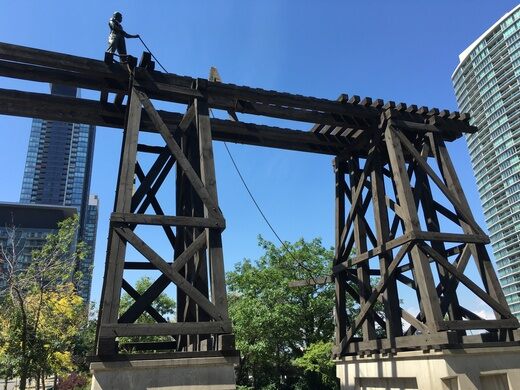
2. The Chinese Railroad Worker's Memorial, located at Spadina and Front near the Sky Dome, is by Eldon Garnet and Francis Le Bouthillier. We spent some time here talking about the history of the railway and the poor treatment of Chinese workers.
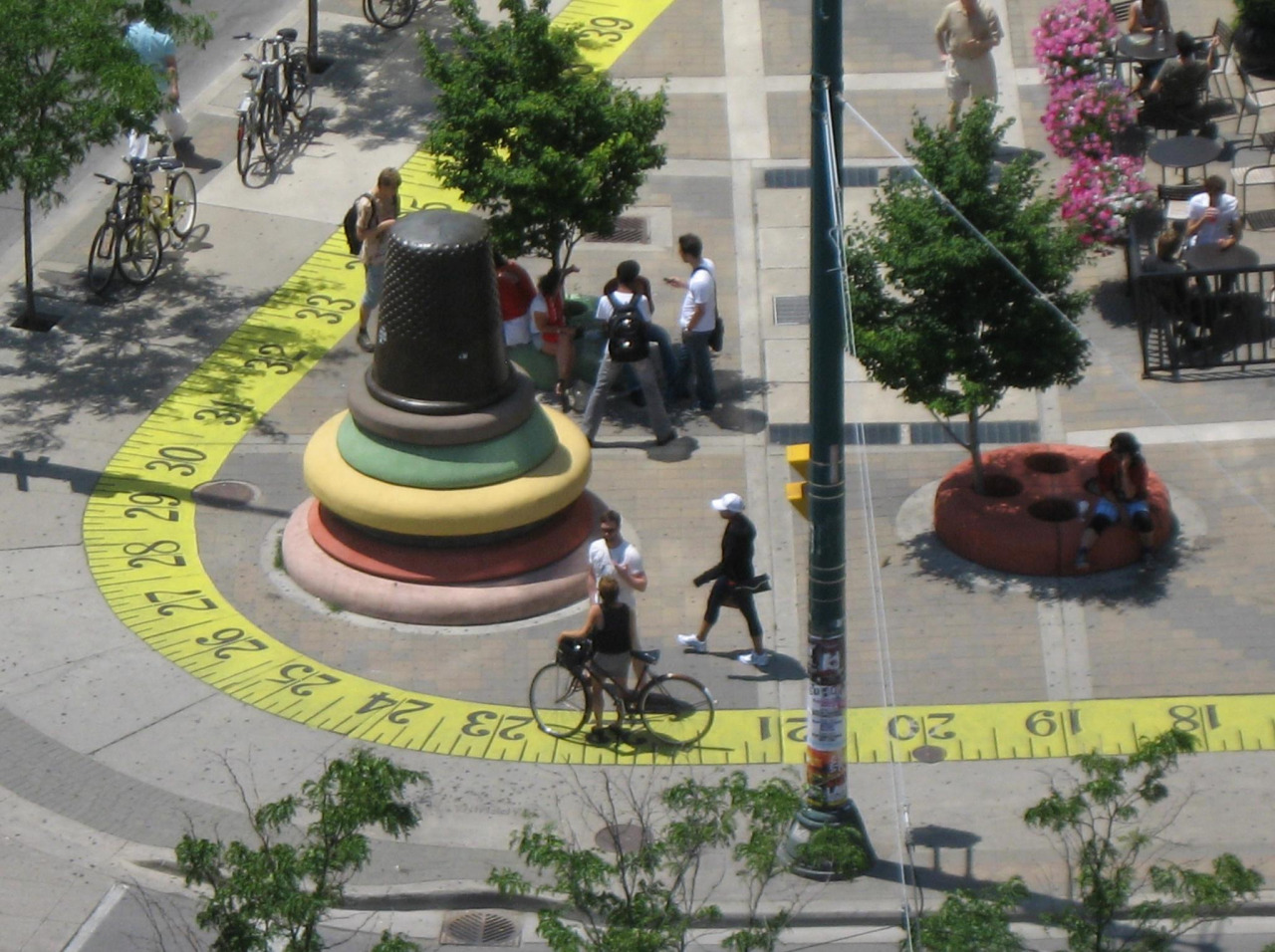
3. Finally, we stopped at The Thimble and Buttons at Richmond and Queen before getting on the streetcar back towards school. This piece, actually called Uniform Measure/Stack by Stephen Cruise, is missing the measuring tape that used to be part of it, but still commemorates the area's history as the Garment District.
I used this last stop to as an excuse to talk about the Triangle Shirtwaist Factory Fire, which was one of the deadliest industrial disasters ever. Because doors to the stairwells and exits were locked to prevent workers from taking unauthorized breaks, 146 people died, many of them women and recent immigrants. The outrage from this tragedy did lead to more regulations and safety standards. Here's a link to the Wiki article: https://en.wikipedia.org/wiki/Triangle_Shirtwaist_Factory_fire
Shirtwaist Factory Fire (photo from Wikipedia)
Spadina and Kensington Market is an area filled with the history of different groups that have emigrated to Toronto, from the Jewish community that dominated the areas in the 20's and 30's, the Hungarians in the 50's, the Chinese Canadian community and the Portuguese Canadian community starting in the 60's, all the way to the current influx of Latin American restaurants and food stores. I asked students to look for different languages as we went up the street and there were many different scripts to be found.
Of course, I barely skimmed the surface of this history in our little walk and I missed some bits that I'd loved to put in for a next time, but we enjoyed our walk and learned to always read the plaques.
Sincerely,
Ms. Goegan
P.S. There are so many rabbit holes to fall into on this topic, I couldn't resist adding some more articles--especially the ones with historical photos to help show the history in some more detail.
Our unit math test was delayed due to picture day on Thursday, but we're back on track. Today we spent time reviewing some of the key learnings that will be on the test. As a result, we don't have a math homework piece this week, but since our Jump Math workbooks have come in, I did send them home with students.
The chapter we've been working on covers material in pages 1-20. Some of that has already been done in class in their notebooks, or sent home as homework, but students who want to make sure they're prepared are welcome to use the book as extra practice for tomorrow. Students could also review the 2 unit quizzes that have already been sent home to see where they should focus in.
Going forward, we'll use the Jump Math workbook as our main focus for in class work.
As we finish another week in the classroom, I wanted to give an overview of what we've been working on:
This week students completed an artist statement based on their Kandisky work from last week in Art and we practiced a new improv game called Bippity Bippity Bop for drama.
In Gym, we've been working on co-operative games, mostly using the parachute this week, and we started our Health curriculum with a discussion about reasons people eat (Medical, Social, Societal, Emotional).
We began our Social Studies program by talking about Orange Shirt Day and some of the Push/Pull Factors for Immigration to Canada. When we talked about symbols that represented Canada, a lot of the students chose animals. When we talked about things that represented their own family's arrival to Canada, many chose to focus on cultural foods, like pierogies or potatoes. These are valid choices, but when we talked about Orange Shirt Day and the challenges that Black Loyalists faced, I felt like students engaged in the bigger ideas that ground our unit, so I hope to move forward with that. We'll be doing some of that through partnering with Ms. Khokar in the Library.
For Language, we read together from the class novel and they wrote a reading response based on a shared discussion question. For writing, they handed in a polished copy of a paragraph to show their understanding of paragraph structure, and we are busy making pop-up book pages in groups to explain some grammar terms like nouns, verbs, adjectives, adverbs, prepositions, and punctuation. I will start sending home grammar homework for practice next week.
For math, we've been working through the Nelson textbook in Patterning and Algebra, with support from JUMP math. Now that our new workbooks have arrived, I hope to do more work with the JUMP program. Today, we worked on the mid-unit quiz from JUMP, which will go home Monday along with the homework--another practice quiz. I sat with all my math groups today to review their understanding of the trickier patterns that change (Patterns that go up by a new number each time are harder to make algebraic rules to move from x to y, so we might use t-charts or pictures to support.). I will continue to send home math homework to be completed by Friday, on a weekly basis.
I also have been giving them quizzes to see where their computation skills are. For students who need to practice, the following sites have been recommended to me by Ms. Filan for good math games:
We're using yellow folders to communicate back and forth from home, to write out our agendas, and to stay organized.We're spending time daily, reviewing those organizational details, to help students get in good habits for their future.
We are working on abstract art concepts in class, focusing on the example of Wassily Kandinsky. We started with Peter Reynolds' The Dot, which shows kids that we can all be artists and then I showed this slide show, which gives a couple of ideas about how to do projects based on Kandinsky's work at the end.
I also showed part of this video in class and thought it might interest some of you to review in more detail. It talks a bit about Kandinsky's synesthesia.
You can also watch this animation, which includes some inspirational music.







.jpg!Large.jpg)
.jpg!Large.jpg)
.jpg!Large.jpg)